

Time that shapes us
Why change is the mechanism and time the human framework
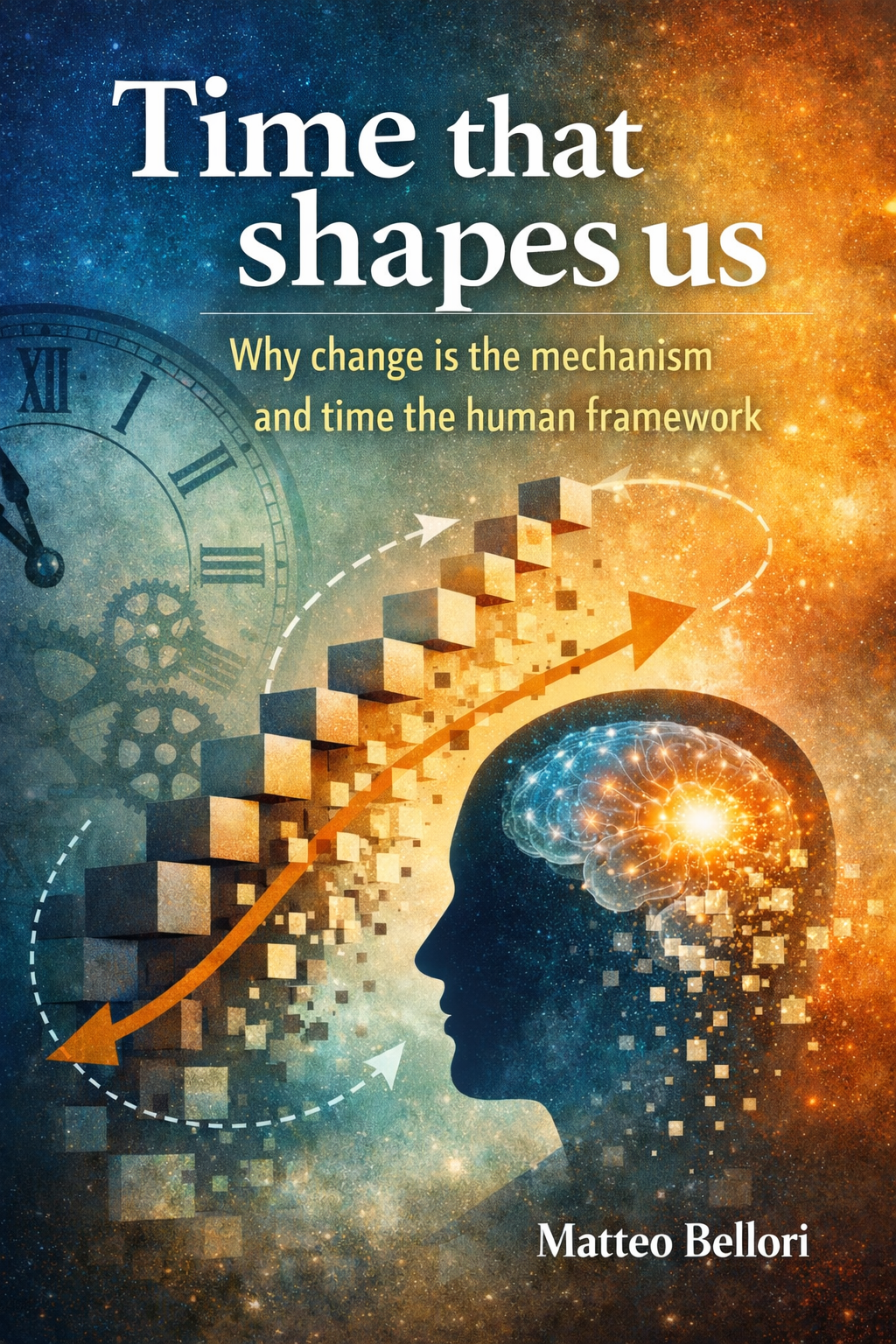
Time that shapes us: Why change is the mechanism and time the human framework develops a structural account of time that departs from the common assumption that time causes change. Instead, the book argues that change is primary, and time is the human framework through which structured change is ordered, experienced and interpreted.
The central claim of this book is precise: time is not an independent force acting upon reality. Time does not push, move or transform anything. What exists are processes of change. What we call time is a cognitive and structural ordering of those processes. It is the framework through which human beings coordinate, narrate and stabilise change.
This distinction is not semantic. It restructures how we understand causality, identity and continuity.
Change as the mechanism
The book opens by questioning a deeply embedded intuition: that time passes and that things change because time passes. In everyday language we say that time heals, time destroys, time shapes us. But structurally, nothing changes because time moves forward. Systems change because internal and external conditions shift. Biological systems reorganise. Psychological states fluctuate. Physical systems transform through interactions.
Change is the mechanism.
Time is the ordering schema.
By separating these two, the book clarifies confusion at the intersection of physics, philosophy and lived experience. Time becomes a relational measure of structured transitions rather than a causal agent.
Time as a human framework
If change is primary, what then is time?
The book proposes that time is a human framework for coordinating change. It is the stabilising grid through which events are compared, sequenced and interpreted. Without change, time would have no content. Without structured ordering, change would have no intelligibility.
Time therefore functions as:
- A cognitive ordering principle
- A narrative scaffold
- A coordination mechanism across systems
- A shared social structure
It allows continuity to be perceived where processes are in constant transformation. It makes identity possible across change.
This connects directly to the broader structural framework developed across the work: systems remain identifiable not because nothing changes, but because change remains within tolerances that preserve coherence.
Identity across change
One of the book’s key contributions is linking time to identity.
We experience ourselves as continuous across years. Yet biologically, psychologically and socially, we are in constant transformation. If time does not cause change, then personal identity cannot be explained by temporal duration alone.
Instead, identity persists because structural coherence is retained under ongoing change.
Time provides the narrative container in which this coherence is interpreted as continuity. The human sense of “having a past” and “moving toward a future” is not proof that time drives change. It is evidence that the mind organises change within a structured temporal framework.
This repositions classic questions such as:
- Are you the same person over time?
- Does time shape who you become?
- Is time fundamental or derived?
The book argues that identity is maintained through retained coherence, while time is the framework that renders this coherence intelligible to us.
Time and causality
A major implication of the argument concerns causality.
If time does not cause change, then causality must be understood in structural terms rather than temporal flow. Events do not occur because time has advanced. They occur because structural conditions reach thresholds that produce transformation.
Time records and orders these thresholds. It does not generate them.
This reframing has implications for:
- Philosophical debates about whether time is real
- Scientific discussions about temporal direction
- Psychological experiences of aging and development
- Existential interpretations of mortality
The book does not deny the lived reality of time. It reframes its ontological status.
Psychological and existential implications
When people say that time shapes us, they often refer to memory, development, trauma, learning or aging. This book does not dismiss those experiences. Instead, it examines their structure.
We are shaped by accumulated change. Time provides the framework through which accumulation is recognised and interpreted.
Memory is not the storage of time. It is the retention of structured change. Anticipation is not access to future time. It is projection of possible change.
Understanding this distinction clarifies why identity can feel stable despite transformation — and why it can fracture when coherence breaks.
The book therefore contributes not only to metaphysical debate but also to questions of personal continuity, self-understanding and existential orientation.
A structural reorientation
Time that shapes us: Why change is the mechanism and time the human framework offers a systematic reorientation:
- Change is ontologically primary.
- Time is structurally secondary.
- Identity persists through retained coherence under change.
- Continuity is not the absence of transformation but its regulation.
Rather than treating time as a mysterious flow, the book situates it within a broader structural account of systems that remain coherent while transforming.
This places the work in dialogue with discussions about whether time is real, whether time is fundamental, and whether temporal experience reflects objective structure or cognitive organisation.
Who this book is for
This book is written for readers interested in:
- The philosophy of time
- Structural accounts of identity
- Change and continuity
- Causality beyond temporal intuition
- The relationship between experience and structure
It speaks to those who ask:
- Is time real?
- Does time cause change?
- What does it mean to remain the same across transformation?
By distinguishing mechanism from framework, the book clarifies longstanding conceptual confusions and offers a coherent alternative grounded in structural reasoning.
Position within the broader framework
This book forms part of a larger project developing a domain-independent structural theory of identity under change. Within that broader framework:
- Identity is retained coherence.
- Meaning arises within structured continuity.
- Consciousness is experienced identity.
- Time orders change without causing it.
Time that shapes us articulates the temporal dimension of that structure.
It does not treat time as illusion. It treats it as framework.
It does not deny change. It grounds it.