

What makes identity possible?
Not what identity is — but when it can exist.
The Problem of Identity
(How something can change and still remain the same)
Everything changes.
Yet some things remain the same.
This is the problem every theory of identity must solve.
How can something change — and still remain the same?
If identity depended on fixed components,
it would disappear as soon as those components change.
If identity depended on a static structure,
it would disappear under transformation.
If identity depended on external classification,
it would not belong to the system itself.
Yet stable entities exist.
So what actually persists?
What persists is not the material —
but the relations between components.
That relational continuity is called coherence.
Stability exists when coherence is preserved within limits of change.
The Bellori Framework makes this condition explicit.
A structural alternative to existing identity models
Most existing models explain identity and stability within specific domains:
- Developmental models (e.g. Erikson) describe identity across life stages
- Narrative models explain identity as constructed through personal stories
- Dynamic systems models describe stability as attractor states
These approaches are valuable, but they share a limitation:
They describe how identity behaves, but not what structurally makes identity possible.
Unlike developmental, narrative, or domain-specific models, the Bellori Framework explains identity and stability from a single structural condition.
The Bellori Framework introduces a domain-independent model in which:
- stability is defined as preserved coherence within bounded tolerance
- identity emerges from stable configurations
- meaning arises from self-maintaining identity
This allows identity and stability to be explained using the same structural principle across physical, biological, and cognitive systems.
The Structure of Bellori Framework
Bellori Framework
A domain-independent structural framework explaining identity as preserved coherence under change.
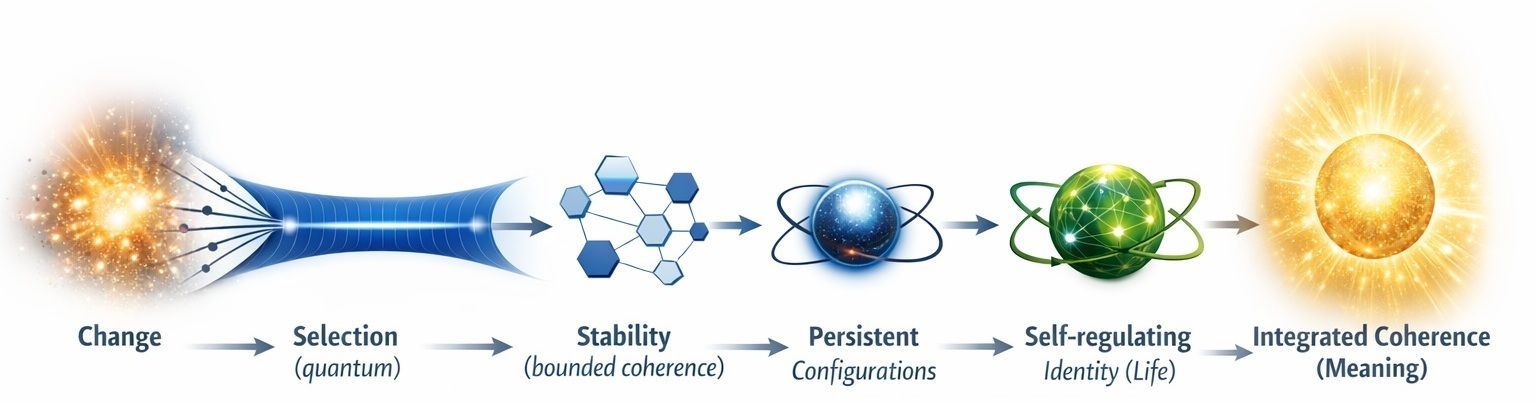
The full structure of the framework is summarised in the framework structure.
Based on the published overview paper:
Bellori Framework: A Structural Theory of Identity and Stability (DOI)
This work is organised as a layered structure,
each level answering a different aspect of the same constraint:
Ontology level
↓
↓
↓
Observer level
4. Identity (Sequences)
↓
5. Life (Self-Regulating Identity)
↓
6. Meaning (Coherence expansion)
Each layer is developed in a dedicated whitepaper.
Together, they form a
single coherent framework.
0. CHANGE (MECHANISM)
(Why change, not time, underlies all structure)
In many scientific and everyday explanations, time is treated as if it drives change. Processes are described as unfolding “over time,” as though time itself acts as a causal force. However, this assumption is rarely examined, and often functions as a placeholder rather than an explanation.
In this framework, change is treated as the actual mechanism through which systems evolve, while time is understood as a descriptive ordering of change, rather than a causal mechanism, used to order sequences of change. This distinction removes time as a causal explanation and replaces it with structurally observable transitions between configurations.
All subsequent layers in this model — from quantum possibilities to meaning — are therefore grounded in change. Stability, identity and persistence are not properties across time, but properties of systems that remain coherent while undergoing continuous transformation.
1. QUANTUM POSSIBILITIES
(Bridge between probability and reality)
At the most fundamental level, physics describes reality as a space of possibilities. Quantum mechanics provides a highly accurate mathematical framework that defines which configurations can in principle exist, expressed as probability distributions over possible states. However, this framework does not fully explain why one specific outcome becomes actual while others do not, beyond describing statistical likelihoods. The transition from possibility to concrete reality therefore remains conceptually underdetermined in many interpretations.
This work addresses that gap by introducing a structural constraint on what can count as a physical state. A configuration that does not produce consistent outcomes under repeated interaction cannot be empirically identified, and therefore cannot function as part of physical reality. In this view, reality is not simply the realisation of one possibility among many, but the subset of possibilities that can sustain consistent interaction. This reframes the quantum-to-classical transition as a problem of identifiability, rather than probability alone.
2. STABILITY (SELECTION)
(Why some possibilities persist)
Once the space of possibilities is defined, the next question is why certain configurations persist while others disappear. In standard physics, this is often described through mechanisms such as decoherence, which explains how quantum superpositions lose observable interference through interaction with the environment. While this explains how classical behaviour emerges, it does not fully specify why only certain configurations remain stable and reproducible.
In this framework, stability is understood as a selection principle rather than a secondary effect. Only those configurations that maintain consistent outcomes across interactions can persist over time, because only they can be repeatedly identified and reconstructed. Configurations that fail this criterion effectively dissolve into inconsistency and cannot form part of observable reality. Stability is therefore not something that happens within reality, but something that determines what can appear as reality in the first place. Decoherence describes the process, but stability defines the structural condition that makes persistence possible.
3. PERSISTENT CONFIGURATIONS
(The Core Structure)
At this level, the framework formalises what it means for something to persist. Existing scientific disciplines describe stability in many different ways — such as homeostasis in biology, resilience in systems theory, or identity in psychology — but these concepts are rarely unified within a single structure. As a result, the underlying mechanism of persistence remains fragmented across domains.
The framework introduces a general model in which systems are described as configurations of elements and relations that evolve through transformation. Persistence is defined in terms of relational coherence: successive configurations must retain sufficient structural overlap to remain identifiable as the same system. This makes continuity measurable rather than assumed.
From this perspective, coherence is not a chosen interpretation but a structural necessity. If no overlap exists between successive states, no continuity can be established and no system can be identified. Tolerance emerges naturally within this model, as the bounded range within which variation can occur without breaking coherence. This provides a single formal structure that connects physical systems, living organisms, cognitive processes and organisations as different expressions of the same underlying principle: preserved coherence under change.
This makes persistence not an assumed property, but a structural condition that can be analysed across domains.
4. IDENTITY (SEQUENCES)
(Identity as continuity over change)
Identity is often treated as something a system “has” at a given moment, whether in physics, biology or psychology. In practice, however, identity cannot be determined from a single state. A snapshot does not reveal whether a system remains the same, because identity only becomes visible across change.
In this framework, identity is defined as a property of sequences rather than states. A system is identifiable when successive configurations remain structurally compatible within a bounded range of variation. This means that identity is inherently dynamic: it requires ongoing change, but within limits that preserve coherence. When those limits are exceeded, identity does not gradually weaken but structurally breaks, resulting in transformation or loss of the system.
This perspective aligns phenomena across domains, from biological continuity to personal identity and organisational stability. Identity is therefore not an intrinsic label or fixed essence, but the observable continuity of a system that remains coherent while it changes.
5. LIFE
(Self-regulating identity under change)
Life introduces a structural distinction within identity.
While some systems remain stable only as long as external conditions remain compatible, others contribute to maintaining the conditions required for their own persistence. This structural distinction defines life.
Life is not a separate ontological layer, but a regime within identity in which transformation becomes internally constrained. The system no longer passively follows available transitions, but restricts its own transformation space to those that preserve coherence.
In this regime:
- transformation is partially determined by the system itself,
- the tolerance domain is actively maintained,
- and coherence is preserved through internal regulation.
Life therefore marks the transition from passive identity to self-regulating identity under change. When such self-regulating systems are exposed to increasing configurational pressure, maintaining coherence may require expanding the range of viable configurations. This transition leads to the emergence of meaning.
6. MEANING
(Meaning as structured coherence expansion)
Meaning emerges specifically in systems that must expand their coherence in order to maintain identity under increasing configurational pressure.
Meaning is typically approached as a psychological or philosophical concept, often treated as subjective interpretation or symbolic value. While these perspectives capture important aspects of human experience, they do not explain why meaning emerges in structured systems at all. Without a structural basis, meaning remains difficult to connect to physical or biological processes.
Within this framework, meaning is understood as an emergent property of interacting identities. When systems maintain coherence while integrating new relations, their capacity to handle change expands. Meaning appears when this expansion becomes necessary for continued stability, not as an abstract layer but as a functional consequence of preserved coherence under increasing complexity.
In this sense, meaning is not added to reality, but arises from it. It reflects the successful integration of change within systems that remain identifiable, linking physical persistence, identity and experience within a single continuous structure.
Frequently Asked Questions
What determines which quantum possibilities become physical reality?
Quantum theory describes a space of possible configurations, but not all possibilities become reality. In this framework, only configurations that produce consistent outcomes under repeated interaction can be identified and therefore persist as physical reality.
Why do some systems remain stable while others lose coherence?
Physical states remain stable when they maintain consistent interaction outcomes. Configurations that cannot reproduce consistent results cannot be identified or sustained, and therefore do not persist as part of observable reality.
How does identity persist in systems that continuously change?
Stability refers to the ability of a system to remain consistent under change. Identity emerges when this stability is preserved across successive configurations, allowing a system to remain recognisable as the same while it evolves.